- 1 The Loftier Low method
- 1.1 The High Low method
- 1.ane.ane Footstep 1
- i.1.2 Footstep two
- ane.ane.iii Pace 3
- 1.1.iv Stride 4
- 1.ii Assumptions
- 1.3 High low method with stepped stock-still costs
- 1.4 High low method with changes in the variable cost per unit
The Loftier Low method
Hello-low is linked to the idea of cost behaviour and is one method for splitting semi-variable costs into their fixed and variable elements.
Making a distinction between fixed and variable costs in a semi-variable price might be used:
- in product costing
- to analyse profitability of a product or department
- to aid managers to make decisions nigh increasing/decreasing activity levels
- to approximate hereafter costs (forecasting and budgeting)
- to guess what costs should have been (for budgetary control and performance assessment).
The Loftier Depression method
The full cost of a semi-variable cost can be shown as:
Total costs = Total fixed costs + (Variable costs × Activity level)
To separate the fixed cost element from the variable toll chemical element the high low method tin can exist used.
Pace 1
Select the highest and lowest activity levels, and their associated costs. (Note: do non take the highest and lowest costs)
Step ii
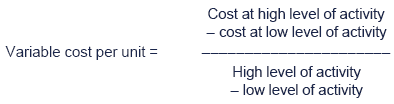
Calculate the variable cost per unit:
Step 3
Calculate the fixed cost by exchange, using either the loftier or low activity level.
Stock-still cost = Full cost at activeness level - Full variable cost
Stride four
Use the total fixed cost and the variable toll per unit of measurement values (steps two and three) to summate the estimated cost at dissimilar activity levels
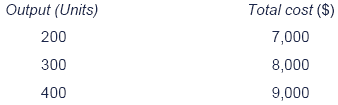
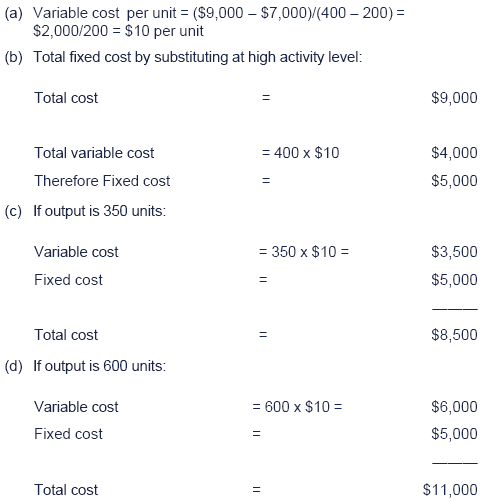
Analogy - Applying the high low method
Assumptions
Assumptions of the high low method are equally follows:
- the cost under consideration is potentially semi-variable (i.e. it has both fixed and variable elements)
- the linear model of toll behaviour is valid i.e. y = a + bx
High low method with stepped fixed costs
Sometimes stock-still costs are simply fixed inside certain levels of activity and increase in steps as activity increases (i.e. they are stepped fixed costs).
- The high/depression method tin withal be used to estimate stock-still and variable costs. Merely choose two activity levels where the fixed cost remains unchanged.
- Adjustments need to be fabricated for the stock-still costs based on the activeness level under consideration.
Illustration - high low with stepped fixed costs
An organisation has the following total costs at 3 activity levels:

Variable cost per unit is constant within this activity range and there is a step up of 10% in the total stock-still costs when the activeness level exceeds 5,500 units.
What is the full cost at an activity level of five,000 units?
Calculate the variable cost per unit past comparing two output levels where fixed costs will be the aforementioned:
Variable cost per unit of measurement = [(54,800 - fifty,000) / (7,500 - 6,000)] = $three.xx
Total fixed cost above 5,500 units = [54,800 - (seven,500 x 3.20)] = $30,800
Total fixed price below 5,500 units = thirty,800/110 x 100 = $28,000
Total price for v,000 units = [(v,000 x 3.twenty) + 28,000] = $44,000
High low method with changes in the variable toll per unit
Sometimes at that place may be changes in the variable cost per unit, and the high low method tin notwithstanding be used to make up one's mind the stock-still and variable elements of semi-variable costs by choosing 2 activity levels where the variable cost per unit of measurement remains unchanged.
Illustration - High low with variable cost changes
The post-obit data relates to the manufacture of Product LL in 20X8:

For output volumes higher up 350 units the variable cost per unit falls past 10%. (Note: this autumn applies to all units - non just the excess above 350).
Estimate the toll of producing 450 units of Product LL in 20X9.
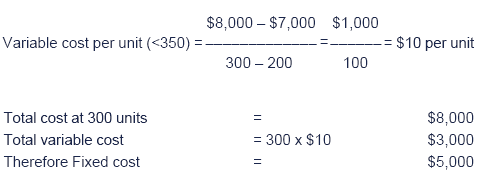
If output is 450 units in 20X9:

(W1) Variable price per unit in 20X9 (when output > 350 units) = $10 x 0.9 = $9 per unit

| Created at 5/31/2012 12:24 PM by System Account (GMT) Greenwich Mean Time : Dublin, Edinburgh, Lisbon, London |
Last modified at 4/26/2013 3:42 PM past System Business relationship (GMT) Greenwich Mean Time : Dublin, Edinburgh, Lisbon, London
| |
| |
| |
Rating : |  Ratings & Comments (Click the stars to rate the page) Ratings & Comments (Click the stars to rate the page) |
| |
Tags: | hullo-depression;semi-variable costs |
0 Response to "How to Find the Variable Costã¢â‚¬â€¹ Slope of aã¢â‚¬â€¹ Line Using theã¢â‚¬â€¹ High low Method and Try Again"
Post a Comment